Loading...
Loading...
Impact, facilities, methodology, and collaborations driving our research program

American Chemical Society (ACS)
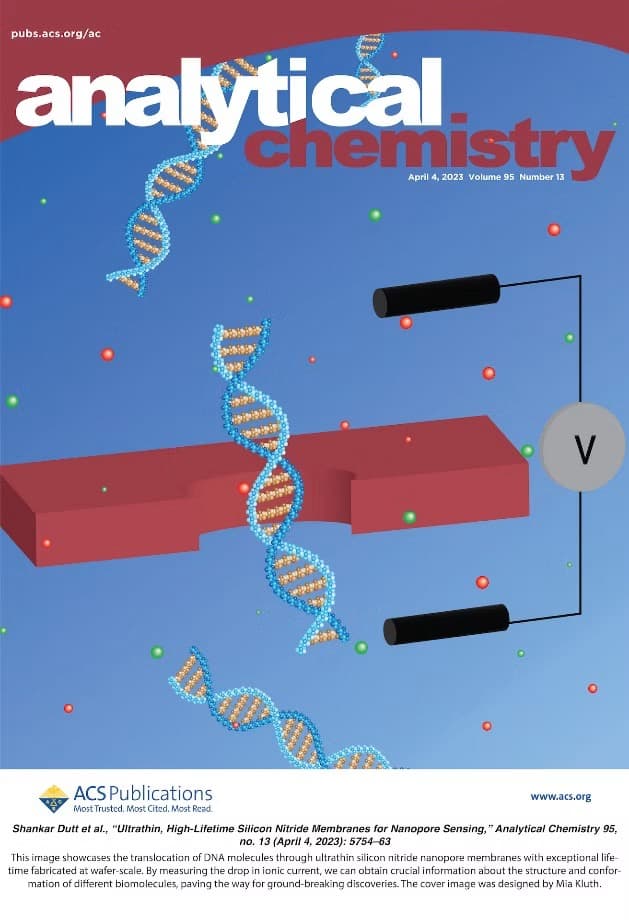
Our research on solid-state nanopore biosensing was selected for the cover of ACS Analytical Chemistry — one of the highest-impact journals in analytical science.
Our protein identification research achieved global recognition, featured in over 100 international media outlets including ABC News Australia, 2GB Radio, Cosmos Magazine, and Science Daily. This work demonstrates the potential for early Alzheimer's detection from a single drop of blood.
Our interdisciplinary methodology combines experimental innovation with computational analysis
Advanced fabrication techniques including ion beam irradiation, controlled breakdown, and atomic layer deposition for creating ultra-thin nanopore membranes.
State-of-the-art electrical measurements capturing single-molecule translocation events with microsecond temporal resolution.
Advanced imaging and scattering techniques to understand nanopore geometry and membrane properties at the atomic scale.
Cutting-edge AI algorithms for automated event detection, classification, and biomarker identification from nanopore signals.
Co-managing state-of-the-art laboratories enabling cutting-edge research
High-bandwidth nanopore sensing systems with up to 10 MHz acquisition, supporting single-molecule protein and nucleic acid analysis.
Complete nanopore fabrication suite including controlled breakdown systems and track-etch technology for membrane production.
Atomic layer deposition and characterization facilities for advanced membrane functionalization and coating development.
NVIDIA GPU clusters and Google Cloud resources for machine learning model development and large-scale data analysis.
I'm always looking for opportunities to collaborate on innovative biosensing and diagnostics research.